
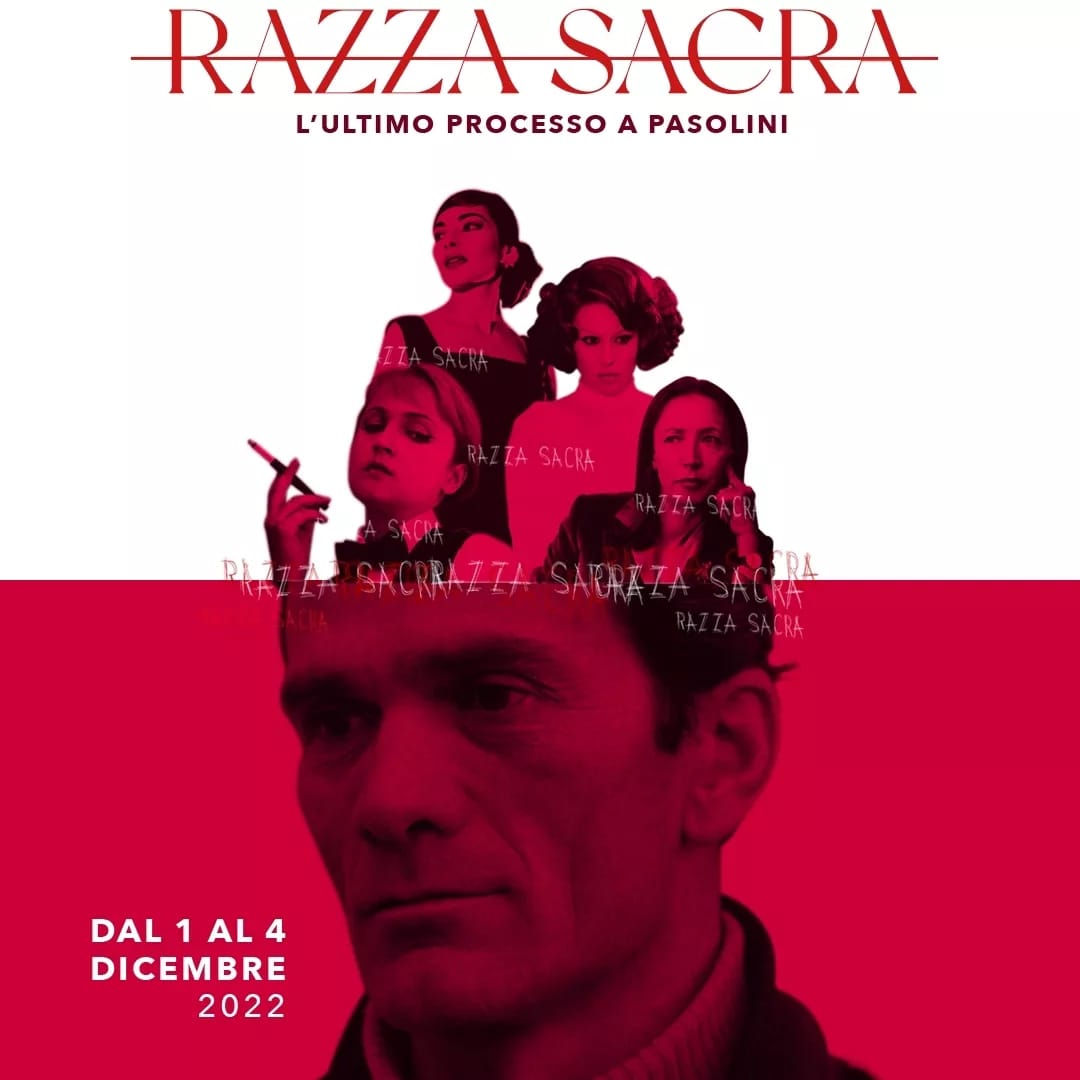
From Thursday 1st to Sunday 4th December 2022
At OFF/OFF Theatre, Via Giulia, 20 – Rome
SHOW TIMES: Tuesday to Saturday at 9:00 PM, Sunday at 5:00 PM
SPECIAL TICKETS FOR ARCIGAY MEMBERSHIP: 13 Euros.
ARTISTIC DIRECTOR SILVANO SPADA
Maurizio Marino's Art Library
presents
SACRED RACE
Pasolini's last trial
Theatrical Project by Mariano Lamberti and Riccardo Pechini
Written by Riccardo Pechini with Mariano Lamberti
with
Marco Vergani and Marina Remi
Marco Vergani: Pasolini | Marina Remi: Laura Betti | Oriana Fallaci | Maria Callas | Silvana Mangano
Sets by Giuliano Pannuti | Costumes by Valeria Ricca | Music by Andrea Albanese | Choreography by Marco Angelilli
Direction
Mariano Lamberti
Closing the centenary of Pier Paolo Pasolini's birth.
There is an aspect of the writer's life that is rarely explored in depth: his relationship with women.
From Maria Callas to Fallaci, Betti and Morante, from Silvana Mangano to Anna Magnani.
From Thursday, December 1st to Sunday, December 4th, 2022, the OFF/OFF Theatre stage hosts a tribute to Pier Paolo Pasolini entitled "Razza Sacra – L'ultimo processo a Pasolini," starring Marco Vergani and Marina Remi in the theatrical project written by Mariano Lamberti and Riccardo Pechini.
There is a vitally important aspect of Pasolini's life that has rarely been explored in depth: his relationship with women. Some photographs are deeply imprinted in the collective imagination (that virile and passionate kiss with Maria Callas, the strolls through the alleys of Rome with Laura Betti...), but the role of the feminine in Pier Paolo's existence and in his personal and artistic definition remains a largely unexplored territory. His life was marked by women of immense cultural (Fallaci, Morante, Bemporad...) and artistic importance (Silvana Mangano, Anna Magnani, and of course "Maria"). Women connected to him in a visceral, tormented, conflicted, or adoring way, whom Pier Paolo repaid with profound affection, taking on the roles of father, older brother, and above all, son. There is no doubt, then, that the feminine inevitably permeated his perception of the world. There is also an even deeper, unexplored feminine, with which Pier Paolo related in contradictory ways. The disgust for the womb, the blood and the viscera (which Oriana Fallaci reproached him for, when the poet confessed to her that he was unable to read her “Letter to a Child Never Born”), but at the same time also the transport
unconditional toward the wounded and usurped feminine (even when it concerns extraordinary figures like Maria Callas or Silvana Mangano). And then, there's Susanna. His mother. The woman who so permeated Pier Paolo's life that she rose to the status of Madonna (as in his Gospel according to Matthew), to a Love so absolute that it became a prison. A woman unlike any other. Endowed with flesh and blood (the scent of primroses in bloom on her coat becomes a sensorial memory capable of evoking in the poet a searing passion) yet wonderfully liberated from the body that looms material and cumbersome over all the other presences in Pier Paolo's life. A woman to whom the poet will dedicate verses so devastating as to become enigmatic ("in your grace, my anguish is born"). Verses to which the show will give a new and surprising interpretation.
SYNOPSIS
A man wakes up in a dark place eerily reminiscent of a prison. He looks around disoriented. He barely remembers his name, Pierpaolo. No other clues as to his identity or why he ended up there. Inside the cell, a bizarre female figure appears, one he doesn't initially recognize: Laura Betti. Like a sort of elf, or rather a healing witch, she prompts him to recall a mysterious event of which Pierpaolo has erased all memory. He overcomes his amnesia by reliving moments spent with three key women in his life: Maria Callas on the beach at Grado, Fallaci in a New York hotel, and Silvana Mangano on the set of "The Witches," which he himself directed. These are episodes that are only apparently biographical, as the three women will abandon their human remains to reveal their intimate nature as witches, becoming emissaries of that primordial, wild but also regenerative feminine force, capable of leading Pierpaolo to the completion of a shocking cathartic act that will change his destiny.
THE WITCHES
“"Witch" is the term that has always been used (often derogatorily) to describe courageous, aggressive, intelligent, nonconformist, curious, rebellious, sexually liberated, and revolutionary women. In short, "dangerous" women who seek to overthrow patriarchal tradition. The witch is also the Great Mother who sweeps away the boundaries of rational thought, sinking her roots directly into the unconscious. She is feminine power, uncontrollable like Nature, archaic and vengeful like Medea, but also a generator of life, like God.
THE SHOW
The show employs a register capable of blending seemingly irreconcilable elements in a completely original way. Echoes of Kafka's trial, references to popular witchcraft lore, and strictly biographical episodes from the poet's life. All this organically unfolds in a dramaturgy that, while beginning with the classic stylistic elements of a mystery to be solved, culminates in a final revelation that breaks down the boundaries of reality and offers a glimpse into the soul of the great writer. A finale capable of offering a new interpretation not only of Pier Paolo Pasolini's personal and artistic journey, but also of his tragic death. Great importance will be given to atmosphere, with light designs, evocative multicolored video projections, electronic music enriched by ancient instruments of Northern European folklore, and a contemporary dance number, ranging from taranta to shamanic ritual.